Mary Slessor: What Is Courage, but Faith Conquering Fear?
“God and one are always a majority.”
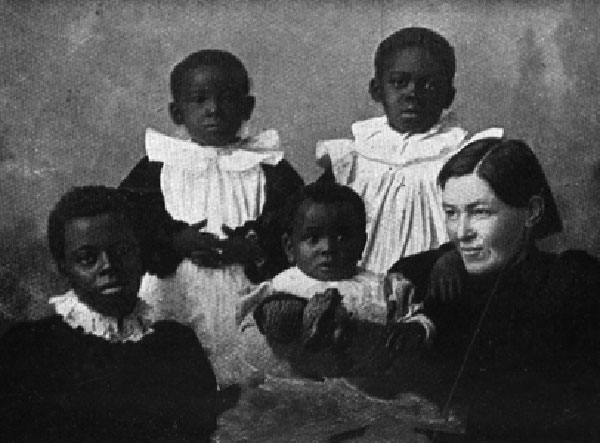
MARY SLESSOR was one of the best-known missionaries of the nineteenth century. A hard childhood in Scotland prepared her for the strenuous life of the mission field. By age eleven she was working in a mill, preparing jute and flax for weavers. As she grew older she became a weaver, able to manage two large looms at once. Home wasn’t much of a place to go. Her father was an alcoholic and often her mother pushed her out into the street so that her father couldn’t beat her. On winter nights, she had to fend off drunks and thieves. Wanting to improve her situation, she attended night classes. When she was too tired to follow the arithmetic lecture, her teacher punished her by making her stand.
Slessor became a Christian after a woman held her hand near a fire and warned her of hell. Soon she was holding Bible classes for children whose lives were as bleak as her own had been. She took groups into the countryside for picnics and even ran races with them, raising the eyebrows of “proper” Christians.
Meanwhile she won the admiration of a gang that tried to intimidate her. They slung mud at her, and their leader whirled a lead weight on a string closer and closer to her face until it grazed her forehead. Praying inwardly, she refused to duck or run. Impressed, the ringleader made his whole gang attend her meetings. “What is courage, but faith conquering fear?” she asked.
Scotland’s churches routinely read missionary letters, which roused Slessor’s interest in foreign lands. She applied to the mission board and was accepted. And so it came about that she sailed for Africa in 1876. She worked in Nigeria where tribes sacrificed people to gods of wood and stone.
Slessor put her life on the line to rescue slaves and women from death. She fought against trial by ordeal, a custom in which innocence was supposed to be established if a suspect did not die from eating poisoned beans or suffer when boiling oil was poured on them. She resisted the use of omens to determine if a widow had a hand in a husband’s death. (Men broke “guilty” wives’ legs and threw them alive into the husband’s grave.) She rescued abandoned children (especially twins), and tried to prevent butchering of slaves when a chief died. Needless to say she fought cannibalism. She also brought the Egbo into derision—groups of masked men who intimidated everyone else. Slessor chased down a group and showed how weak they were by tearing off one man’s mask.
Gradually Slessor taught the Nigerians that lives have value. Her strength was trust in God. “God and one are always a majority,” she declared.
One day she fainted upon reading a letter that informed her Europe was at war. She weakened for two weeks afterward. On this day, Sunday 10 January 1915, she held church service. Afterward she fainted again. A doctor was able to revive her but by 12 January she found it almost impossible to talk. Her last words were a prayer in the Efik language: “O Abasi, sana mi yok.” (O God, release me!). She died the following day.
Other Notable Events
681
Death of Pope Agatho, a Sicilian, who had played a decisive part in suppressing the Monothelite controversy.
1514
Funded by Cardinal Francesco Jiminez de Cisneros, a New Testament polyglot translation is completed in Spain, combining Greek, Hebrew, Latin, and Aramaic texts.
1604
Death of Juliana of Lazarevo (or Juliana of Murom), considered a saint by the Orthodox Church because as a layperson in Russia she lived a righteous life, helping the poor and needy, amidst her care for her own children and others.
1645
Archbishop of Canterbury William Laud is beheaded under a bill of attainder from Parliament. He had been very cruel to Puritans and other dissenters.
1858
Frances Havergal, visiting Germany, writes her first popular hymn, “I Gave my Life for Thee” after seeing a painting of the suffering Christ titled Ecce Homo (“Behold the Man”). Thinking the verses of little worth she throws the paper onto a fire but it falls off. When her father sees the words he composes a tune for them.
1863
Death in New York City of Lyman Beecher, famed anti-Unitarian preacher. In addition to pastoral roles in Connecticut and Massachusetts, he had served as president of Lane Theological Seminary in Ohio.
1883
Death of Elling Eielsen, a lay preacher in Norway, Sweden, Denmark, and the United States. He had migrated to America in 1839 and won many Norwegian emigrants to Christ, traveling the frontier with the gospel message, an axe, a compass, a coffee pot, and rain gear. At Fox River, Illinois, he organized America’s first Norwegian Lutheran congregation—The Evangelical Lutheran Church in America.
1960
A car filled with seven Christian workers plunges into deep water in the Black Umbluzi River but Pastor Phineas Dlamini and the other six escape, some with injuries. Dlamini was a leading pastor in the Church of the Nazarene in Swaziland.
Source: Christian History Institute