
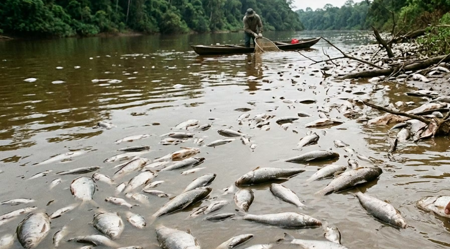
As concern grows over possible chemical contamination of Suriname’s rivers, the Surinamese diaspora in the Netherlands is demanding an independent investigation. Reports of mass fish deaths and possible exposure to cyanide, mercury and other hazardous substances have raised serious questions about public health, environmental protection and mining practices.
The diaspora is calling for transparency, accountability and immediate protection for affected communities, particularly Indigenous and tribal populations whose livelihoods depend heavily on the country’s rivers and forests.
Our man on the scene, Kofi Dyompo Agyeman, follows the developments in this report, as the diaspora prepares to present its petition in The Hague on 28 August, demanding answers to a fundamental question: how long can Suriname extract its natural wealth at the expense of its people and environment?
The controversy has raised concerns extending beyond the environment to public health, food security, biodiversity and the livelihoods of indigenous and tribal communities. Reports of deaths, including teenagers, have further intensified calls for independent and forensic investigations to establish whether there is any connection with the reported contamination.
The diaspora, through the Grani Boni Tula Foundation, is preparing to present an international petition to Suriname’s Ambassador in The Hague on 28 August. The petition calls for transparent investigations, publication of laboratory and environmental data, immediate protection for potentially affected communities and medical monitoring.
The campaign argues that authorities should not wait for every test result before taking precautionary measures. Safe drinking water and food supplies should be provided where necessary, while water, soil, fish, sediment and biodiversity are subjected to long-term monitoring.
At the centre of the dispute is a broader question about Suriname’s extractive economy: who benefits from the country’s natural wealth, and who pays the environmental and social price?
The diaspora says gold and other mineral resources cannot be allowed to take precedence over human life. Where mining activities are found to have caused pollution, negligence or other violations, those responsible should be held accountable, while high-risk operations should be suspended until effective safeguards are guaranteed.
The campaign is also calling for greater protection of Indigenous and tribal communities, arguing that their territories, cultural heritage and traditional dependence on rivers and forests must be recognised in decisions concerning natural-resource exploitation.
For the organisers, however, the issue goes beyond one suspected environmental incident. They want Suriname to reconsider an extractive model in which economic benefits may be concentrated while pollution, health risks and environmental damage are borne by communities and future generations.
They are therefore urging the Surinamese Government to work with affected communities, scientists, civil society, indigenous and tribal organisations and international partners to establish the facts and develop a more sustainable approach to resource management.
As the petition heads to The Hague, the diaspora is sending an uncompromising message: no cover-up, no profit above human life and no extraction without responsibility.
The campaign’s central demand is simple: protect Mama Sranan, investigate now and ensure that Suriname’s natural wealth serves its people without destroying the environment on which their future depends.