
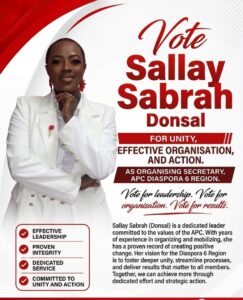
Our versatile reporter Lawal Mohammed continues his coverage of the political campaigning in Sierra Leone. This time he focuses on Sallay Sabrah (Donsal), who is eyeing the Diaspora Organising Secretary – 6th Region, in a contest that could test how seriously diaspora communities take the questions of organisation, inclusion and accountability.
Sabrah enters the race with a message that goes beyond securing a position. Her campaign is built around the argument that a diaspora divided by distance, weak communication and limited coordination cannot fully exercise its collective influence. She is therefore challenging the electorate to consider whether the 6th Region needs another office-holder—or an organiser capable of connecting communities, mobilising participation and turning scattered voices into a coherent force.
Her platform of “Connect • Organise • Empower • Serve” places unity, communication, inclusion, empowerment and accountability at the centre of the campaign. But as Lawal Mohammed reports, the real test will not be the attractiveness of the slogans; it will be whether Sabrah can convince voters that her proposed approach can transform diaspora participation from occasional engagement into sustained political and community action.
The political significance of Africa’s diaspora is no longer measured simply by the number of people living beyond the continent. It is increasingly measured by how effectively those communities organise, communicate, mobilise resources, and translate their collective experience into influence. For the 6th Region, the challenge is therefore greater than electing another office-holder: it is whether diaspora leadership can move from representation to meaningful participation.
Against this backdrop, Sallay Sabrah (Donsal) is presenting her candidacy for Diaspora Organising Secretary of the 6th Region on a platform built around a simple proposition: a diaspora that is not organised cannot exercise its full potential. Her campaign argues that stronger relationships, better coordination and more inclusive participation are essential if the 6th Region is to become an effective force for collective development.
But her message also raises a difficult question for voters: Is the diaspora sufficiently connected, organised and heard today? If communities remain fragmented, if communication flows mainly from leaders to members rather than in both directions, and if women and young people remain under-engaged, then the problem is not merely administrative. It is a leadership challenge.
Sabrah’s campaign seeks to turn that challenge into an agenda for action under the banner “Connect • Organise • Empower • Serve.” She proposes that the Diaspora Organising Secretary should not be a ceremonial position, but a working bridge between communities and leadership—one capable of listening to concerns, coordinating participation and converting ideas into constructive action.
From Representation to Organisation
At the centre of Sabrah’s campaign is unity. She proposes stronger relationships among diaspora communities based on cooperation, respect and shared purpose. The emphasis is significant because diaspora politics can easily become fragmented along geographical, generational, professional or organisational lines.
Her answer is organisation.
Sabrah wants improved coordination and participation across the 6th Region, arguing that communities must have mechanisms through which members can engage consistently rather than only during elections, conferences or major political events.
That places organisation at the heart of her candidacy. The campaign is effectively asking voters to judge leadership not by rhetoric alone, but by its capacity to bring people together and keep them engaged after the campaign banners have disappeared.
The Communication Test
Perhaps the most consequential part of the platform is communication.
Sabrah is calling for stronger channels through which members can express their ideas, concerns and priorities. In an increasingly digital diaspora, the ability to communicate quickly is no longer enough. The harder question is whether communication actually produces participation and accountability.
A genuinely connected 6th Region, her campaign suggests, must allow information and ideas to move in both directions: from leadership to communities and from communities back to leadership.
That could become one of the defining tests of her candidacy.
Inclusion Beyond the Slogan
Sabrah also places inclusion among her central priorities, specifically highlighting women, young people and other sections of the diaspora.
The issue is politically important. Diaspora organisations cannot claim to represent the future of Africa if large sections of the diaspora are treated primarily as audiences rather than contributors.
Her campaign therefore proposes meaningful participation rather than symbolic inclusion. The distinction matters: having people present at meetings is not the same as giving them opportunities to influence decisions.
Turning Diaspora Capital Into Collective Power
Another pillar is empowerment.
The diaspora possesses skills, professional knowledge, international networks, entrepreneurial experience and cultural capital. Sabrah’s platform argues that these assets should be mobilised for collective development.
The question now becomes whether the 6th Region can build structures capable of connecting expertise with opportunity.
That is where the campaign’s vision moves beyond organisational housekeeping. If properly implemented, diaspora organisation could become a mechanism for knowledge exchange, mentorship, investment, advocacy and community development.
Accountability as the Bottom Line
Sabrah’s final priority—accountability—may ultimately be the most demanding.
She is calling for responsible, transparent and service-oriented leadership. Yet such commitments inevitably invite scrutiny: How will accountability be measured? What mechanisms will allow diaspora members to assess performance? How often will leaders report to their constituents? And what happens when promises are not delivered?
Those are questions the campaign will have to answer as the contest develops.
For Sabrah, however, leadership begins with listening, connecting people and organising effectively. Her stated commitment is to work collaboratively across the 6th Region while bringing her experience, energy and organisational skills to the office.
The campaign’s challenge to the electorate is therefore straightforward: Do diaspora communities want another title-holder, or do they want an organiser capable of turning a dispersed population into a connected constituency?
Sallay Sabrah is betting on the latter.
And with her campaign slogan—“CONNECT • ORGANISE • EMPOWER • SERVE”—she has placed the real contest where it arguably belongs: not simply around who should occupy an office, but around what that office should actually deliver.