John Oncken Was Baptized Secretly at Midnight to Evade German Law
At last, Baptists could worship freely.
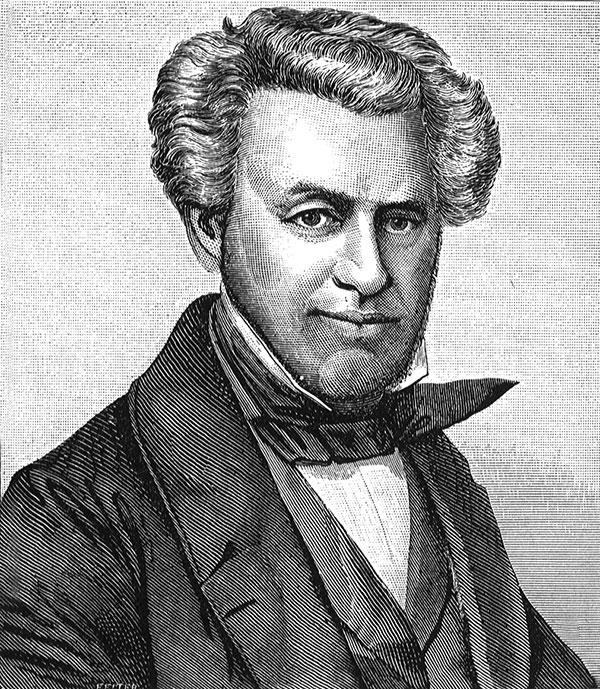
BAPTISTS in Bulgaria, Denmark, Finland, Holland, Hungary, Poland, Russia, and Switzerland look back to one man as their forefather: John Oncken. Oncken was born in Varel, Germany, on this day, 26 January 1800. At fourteen, he sailed to England, where he underwent a transformative conversion to Christianity and joined a Congregational church. Oncken volunteered as a missionary under the newly-formed Continental Society, thinking of his homeland and its need for a heart-felt religion.
He began work in Bremen and Hamburg in 1823 and immediately gained adherents to his evangelical message. The established church resisted his success, but Oncken persisted in his efforts.
These efforts were soon to take a different turn. Studying Scripture, he became convinced that only adult believers should be baptized. American Baptists who crossed his path—providentially it seemed to him—instructed him in the full range of Baptist doctrine. He asked that someone come from England or Scotland to baptize him and a handful of fellow believers. He had to wait five years.
When Baptist minister Barnas Sears baptized the little group, he had to do so secretly as it was against the law in Hamburg. Germans remembered with loathing the Anabaptist rising at Münster three centuries earlier. At Münster polygamy and communism had been practiced. Lutherans also distrusted Baptist teachings, such as separation of church and state, and the autonomy of local congregations, which were so unlike their practice.
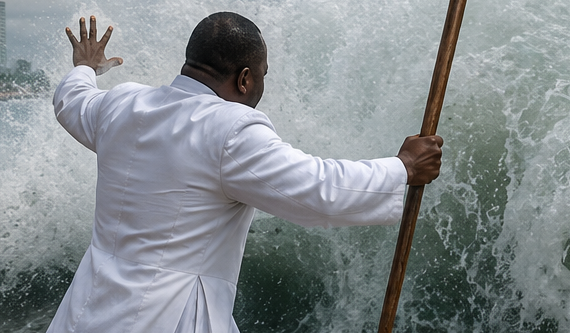
Oncken’s secret baptism led directly to the formation of Germany’s first modern-day Baptist church. He wrote later, “In 1834 a little company of seven believers were rowed across our beautiful Elbe, in the dead hour of night, to a little island, and there descending into the waters, were buried with Christ in baptism… The next day we were formed into a church, of which I was appointed the pastor.”
In spite of Lutheran opposition, John Oncken and his helpers established many churches in Germany and surrounding countries. Because he disobeyed a law that said that groups of more than five people must not meet for worship unless a minister of the state church was present, Oncken went to prison. Authorities seized all his goods to pay his fines. However, local leaders soon relented and released him.
Shortly afterward fire raged through Hamburg, destroying thousands of homes. Baptists gained popular favor by setting up a shelter in a warehouse they owned. There they housed and fed victims of the tragedy at their own expense. Soon afterward, Hamburg’s citizens voted for an act of religious tolerance. At last Baptists could worship freely.
Other Notable Events
404
Death in Palestine of Paula, Jerome’s patron and pupil.
1557
Cardinal Pole leads a cleansing at Cambridge University against the “heretical” preachers Martin Bucer and Paulus Phagius who have both been dead for several years. The sentence excommunicates and anathematizes them and orders their bones be dug out of holy ground and publicly burned. He also interdicts anyone in possession of “heretical” books.
1564
In the papal bull Bendictus Deus Pope Pius IV confirms decrees of the Council of Trent that include repudiation of Calvinist and Zwinglian teachings on the Eucharist; affirmation of penance and extreme unction as sacraments; a reaffirmation that tradition is a source of divine revelation; and a declaration that the Vulgate translation is the only authentic Latin version for public use. Trent also abolished the practice of preaching papal indulgences.
1681
Isabel Alison and Marion Harvie are hanged in Edinburgh for their Covenanter beliefs. They sing Psalm 84 on the scaffold. Marion declares the government has no crime such as murder to charge against her but only religious views. The major in charge of the executions orders the hangman to “cast her over” to choke off any further testimony.
1906
The Church of God (Cleveland, Tennessee), a Pentecostal denomination, convenes its first General Assembly.
1936
Death of African revival leader Blasio Kigozi at Kampala, Uganda, of tick fever. Inscribed on his tombstone will be the word zukuka (“awaken”).
1949
Death in Washington, DC, during the early hours of the morning, of Presbyterian minister Peter Marshall of heart problems at age forty-six. He had been the vibrant and influential chaplain of the United States Senate. His widow, Catherine, will tell his story in A Man Called Peter.
1962
Death of George Jeffreys, founder of Elim Pentecostal Churches, at his home in Clapham, England.
1992
Mr. Boushra Khaliel, a Coptic Christian in Dairut, Egypt, drops charges against militant Muslims who had beaten him severely with pipes, leaving his right arm paralyzed. He had been warned that if he refused to drop the charges, his family would suffer the same brutality.
1996
Father L. Bridget and Sister Vridhi Ekka are sentenced to six months rigorous imprisonment for “forcibly converting” ninety-four Indians to Christianity in the Ambikapur, India, district, although they neither lured nor coerced anyone to become a Christian.
Source: Christian History Institute