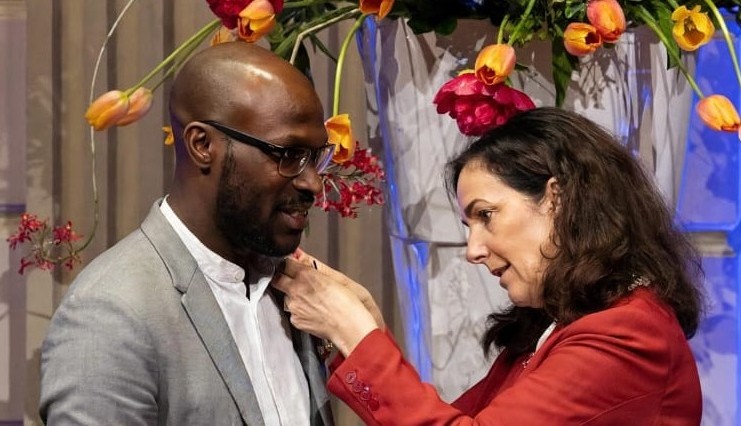
A royal distinction intended to celebrate a lifetime of fighting racism and exclusion has become the centre of a fresh debate over historical justice, symbolic recognition and the price of principle. Mitchell Esajas’s decision to return his royal ribbon has raised an uncomfortable question for the Netherlands: what value does official recognition hold when the inequalities and historical grievances at the heart of an activist’s struggle remain unresolved?
Esajas, recognised for his anti-racism activism and contributions through the New Urban Collective and The Black Archives, has turned what might have been a personal protest into a wider challenge to the establishment. His decision has resonated among supporters who see it as a powerful statement that dignity and conviction cannot be measured by royal honours. It also raises difficult questions about whether ceremonial gestures can meaningfully address the enduring consequences of slavery, discrimination and exclusion.
In a provocative commentary, Columnist Kofi Dyompo Agyemang challenges the Afro-Caribbean Dutch community to reconsider the significance of royal decorations and asks whether others who share Esajas’s concerns should follow his example. His argument goes beyond one man surrendering a ribbon: it confronts the tension between symbolic recognition and substantive change, placing historical truth, equality and reparation at the heart of a debate that the Netherlands can no longer afford to ignore.
Receiving a royal decoration is, for many people a special moment. There are congratulations, beautiful words and photos. But what does such a distinction actually mean when the fight against racism and inequality is still necessary? And what is the use of a royal pat on the back when the problems you are fighting for do not disappear?
Mr Esajas’ decision to return his royal distinction makes us think. It is about more than one man and one ribbon. It is about principles, dignity and the question of whether symbolic recognition is enough when real change fails to materialise.
Within the grassroots, Mr Esajas is enormously appreciated and supported. Not because of his distinction by the descendants of the destroyers, but because of his commitment and his fight against racism and exclusion. With his decision, he shows that principles should weigh heavier than personal honour. That deserves an enormous amount of respect.
Mr Esajas, You Were Honoured For Your Struggle. Why Should You Now Soften That Struggle?
At the award ceremony, Mayor Halsema praised Mr Esajas for his years of commitment against racism and exclusion. She pointed to his work at New Urban Collective, his contribution to The Black Archives and the inspiration that his pioneering work has given to a new generation of activists, writers, scientists and entrepreneurs.
That is precisely the core of this issue. Mr Esajas was distinguished because of his struggle for equality. Then, after the very weak outcomes of the slavery research, it is logical that he has concluded that keeping that distinction no longer fits his convictions.
A ribbon can express appreciation, but it does not solve the problems for which someone is fighting.
A Ribbon Is Not Restoration
Let us be honest: a ribbon does not restore historical injustice. It does not undo generations of destruction and marginalisation. It does not automatically ensure equal treatment and does not provide an answer to the disastrous consequences of racism. A ceremony is not justice. A congratulation is not restoration. And a royal distinction is not reparation for a history that still has an effect today.
Sometimes it seems as if the Dutch royal house likes to give people a ribbon for their struggle, and then simply continues as if everything is in order. The hollow, beautiful words have been spoken, the photos have been taken and everyone goes home. But the problems remain.
That is the uncomfortable question we must dare to ask: is the fight against injustice really being supported, or is it mainly the person who denounces that injustice who is being honoured? A ribbon can mean sincere appreciation. But it should never be confused with real change
.To the Afro-Caribbean Community: What Do We Do With This Message?
Within our community too, there are people who have committed themselves for years to emancipation, equal opportunities and the fight against discrimination. Some have received a royal distinction for this. That does not have to mean that they made a wrong choice at the time.
But time does not stand still. Our consciousness grows and circumstances change. That is why we must ask ourselves again: does this distinction still fit our convictions and the reality in which our community lives?
The call to all Afro-Caribbean Dutch people who have received a royal distinction is therefore clear: take Mr Esajas’ example seriously. Realise that you have been deceived with a worthless ribbon and return it, if you also see that it does not fit your principles. Yes, you too….
Returning a ribbon does not solve everything. But it is a powerful statement: our dignity does not depend on the approval of an institute or the recognition of the state.
Boycott the Ribbons. Make It a Statement!
Let us therefore go one step further. Let us no longer automatically consider royal ribbons as a great honour. Refuse them. Boycott the ceremonies. And those who have already received a ribbon can consider returning it when conscience so demands.
Because let’s be honest: a piece of ribbon does not make anyone bigger. A distinction does not automatically make someone more principled. And a solemn ceremony changes nothing about the history we must face.
Those who fight against exclusion do not do so to eventually be neatly decorated by the system. Those who stand up for justice do so because justice is needed, even when it becomes uncomfortable for those in power. Turn the refusal into a movement. Turn the boycott into a joint statement. Show that our dignity is worth more than a royal pat on the back.
Our Dignity Is Not For Sale
Dear Mr Esajas, your decision touches on a question that is much bigger than one distinction. You show that personal honour does not always outweigh principles. The grassroots and grass-tops carry you in their hands, precisely because you show with this choice that your convictions are not for sale. Your ancestors are proud of the courage with which you are taking this step.
To our community, I would like to say: let us not continue to stand in line for worthless symbolic decorations while the call for historical truth, equality, reparation and justice continues to sound.
Our dignity existed before someone pinned a ribbon on us. And that dignity will continue to exist when we hand it back in. It is not about who is allowed to wear a ribbon. It is about the society we want to build and whether we are willing to really work on it.