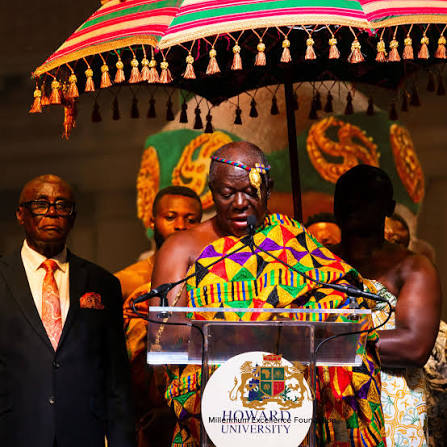
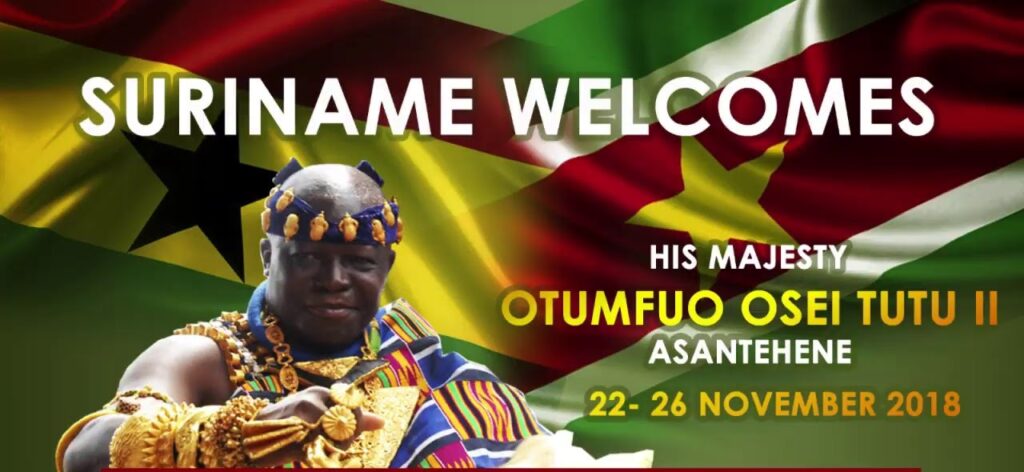
When Otumfuo Osei Tutu II, Asantehene, stepped onto Surinamese soil for the nation’s 50th Independence Anniversary, the moment resonated far beyond ceremonial spectacle. It marked the first time in recent memory that a Ghanaian monarch undertook a coordinated cultural-diplomatic tour across the Caribbean—linking histories, peoples, and futures shaped by the Atlantic.
A Commonwealth of Memory and Meaning
Arriving with a distinguished delegation including Nana Otuo Siriboe II of Juaben and other senior chiefs, the Asantehene’s three-day official visit from November 24 to 27 unfolded like a masterclass in soft power. His presence at Suriname’s Extraordinary Session of the National Assembly on November 25 set the tone. As Speaker Dr Ir. Michaël A. Adhin and President Jennifer Geerlings-Simons delivered their addresses, the Ghanaian monarch’s attentive presence symbolised a shared political heritage—one forged through struggle, sovereignty, and survival.
Outside Parliament, the national parade gathered soldiers, parachutists, and thousands of citizens under the equatorial sun. The Asantehene’s arrival on the ceremonial grounds drew an unmistakable ripple through the crowd: a sense that history was not only being commemorated, but actively reconnected.
In the afternoon, the Presidential Palace turned into the nexus of Caribbean–African diplomacy as the President and her spouse hosted a reception for the golden jubilee. Later in the evening, drums, dance, and theatre filled the capital as His Majesty joined cultural festivities—an exchange rich with echoes of the Akan heritage preserved within the Surinamese Maroon communities.
A Diplomatic Marathon
The final day of the visit became a whirlwind of high-level engagements. From the Presidential Palace at Onafhankelijkheidsplein to the chambers of senior legislators, the Asantehene held back-to-back meetings with President Geerlings-Simons, National Assembly Speaker Dr Adhin, Vice Speaker Ronnie Brunswijk, and other parliamentary leaders including Ingrid Bouterse-Waldring and Chandrikapersad Santokhi.
In each room, the conversations underscored Suriname’s long and complex links to Ghana—particularly through the histories of the Ndyuka and other Maroon groups whose ancestors were taken from the Gold Coast centuries ago. This visit, officials noted, was more than ceremonial diplomacy; it was a reconnection of kinship lines.
Prelude in Barbados
Suriname was not the only Caribbean nation on the Asantehene’s 2025 diplomatic circuit. Two weeks earlier, His Majesty touched down in Bridgetown aboard the first-ever direct flight between Ghana and Barbados—a milestone in itself.
In Barbados, the Asantehene met Prime Minister Mia Amor Mottley, presided over the opening of the Royal Diplomatic Golf Invitational at the Apes Hill Club, and visited the University of the West Indies’ Cave Hill Campus. His presence at the 16th GUBA Awards—celebrating African and diaspora excellence—became one of the highlights of the season.
Homecoming
By the time the Monarch’s aircraft landed at the newly renamed Prempeh I International Airport in Kumasi on November 27, the symbolism of the journey had already taken root across two continents.
The Asantehene’s Caribbean tour was, at its core, a re-mapping of Ghana’s global relationships: scholarly, cultural, diplomatic, and deeply human. It demonstrated how monarchy, when anchored in history and relevance, can operate as a bridge—carrying identity, memory, and renewal across oceans.
Story: Lawal Mohammed