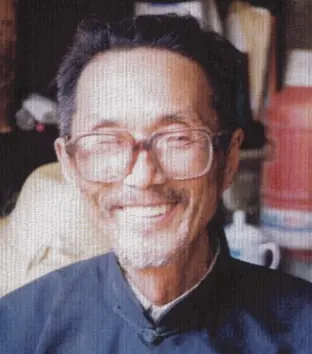
“I am a Christian and will always be a Christian. I cannot and do not plan to reform and transform myself to become a Marxist.”
IN 1951, elders of the Little Flock Church denied Wu Weizun the bread and wine of Communion. As far as they were concerned, he had abandoned the faith. When Chinese communists had forced Christians to denounce each other, Wu did so with such exaggeration that the meeting descended into chaos and the communists shut it down. To Christians, his behaviour seemed evidence of apostasy.
Not so, countered Wu. He explained that he had felt God telling him to make such an absurd denunciation that the meeting would fail. As that was indeed the result, Christian leaders accepted Wu back. In 1956, he married a young woman who assured him she was ready to walk the narrow path of Christian faith with him. Rather than be part of the communist-controlled Three Self Patriotic Movement that co-opted churches, the pair held religious meetings in their home.
Wu’s evident lack of enthusiasm at mandatory communist meetings and his insistence on sharing the gospel put him on a crash course with the Maoists. He was assigned correctional labour and underwent attempts at thought reform. However, he continued to pray openly before meals, to read his Bible, and to participate in Christian worship. Told to hide his faith, he replied, “I am a Christian and will always be a Christian. I cannot and do not plan to reform and transform myself to become a Marxist.” Seeing other Christians suffering imprisonment, he prayed to be worthy of suffering for Christ, too.
His summons came in 1964. When he refused to repeat government propaganda, he was incarcerated, tortured, deprived of sleep, and repeatedly interrogated in an effort to break him. He established four rules for handling interrogation: refuse to respond, refuse to explain, refuse to admit “crimes,” and refuse to repent. Authorities sentenced him to life in prison.
Spiritual battles followed. He would eat only if allowed to say grace aloud. His food was taken away. Then he was accused of going on hunger strike and force-fed through a tube. This was repeated with beatings until the authorities finally gave up and allowed him to say grace and eat in an isolated room every third day. He refused to read Mao’s Little Red Book, to repeat obligatory slogans, to sing revolutionary songs, or to bow to Mao’s portrait. Beatings and hardships did not shake his resolution.
In 1981, a court reduced his sentence, saying he had truly repented of his crimes. Although this ruling would free him in six years, Wu wrote back that he had repented of nothing. Still, he was sent to a better prison and assigned to teach science and math to younger inmates. In 1987, he was freed, but he demanded that the charges against him be rescinded because he had repented of nothing. Out of respect, authorities allowed him to live in a hut outside the walls, kept him on the prison roll, and gave him a small stipend.
Wu spent a little of the stipend on coarse food. The rest went for carbon paper and postage. Over the years, he had written helpful letters to other Christians, and continued to do so. He called this his “Correspondence in the Body of Christ.” Eventually the letters saw publication as Christian Fellowship. He also wrote an autobiography, A Chinese Epaphras.
On this day, 21 December 2002, a young couple knocked on Wu’s door. Getting no response, they jumped a low wall and entered his hut. They found him lying dead on the floor with a peaceful expression on his face. Across China word went out: “Our beloved Brother Wu Weizun has gone to the Lord’s place. We are not saddened by this fact because we hope that we will be reunited before the Lord. We respect him and we miss him.”
Other Notable Christian Events on December 21
1082
Death of Hincmar, Archbishop of Reims, a man of great energy who had acquired considerable influence over the Frankish kingdom.
1406
(probable date) Martyrdom of Juliana of Viazma. Youri, Duke of Smolensk, had tried to seduce her and when he could not, stabbed her husband during a feast and hacked her to death. She became venerated as a saint by the Orthodox Church because of her virtue.
1807
Death in London, England, of John Newton, author of the hymn “Amazing Grace.”
1856
Death in London of John Harris, a preacher, educator, and author. His most famous book was The Great Teacher: Characteristics of Our Lord’s Ministry. He evoked hostile reactions with another book, Mammon, or Covetousness the Sin of the Christian Church. His works were more popular in the United States than in his native Britain.
1896
After fighting against spiritual conviction for months, fifteen-year-old Walter Wilson yields to Christ in Kansas City, Missouri, noticing an immediate change in his own attitudes and behavior. The following year, he will begin holding evangelistic street meetings, eventually becoming a medical doctor and lay evangelist.
1939
Death of Frederick Barnabas Van Eyk, a notable Pentecostal preacher in Australia. He had recently divorced his wife and married a younger woman. Bitten by a tse-tse fly, he refused medical treatment, trusting to faith healing, and died.
1941
The BBC airs the first play in Dorothy Sayers’ cycle The Man Born to Be King. Before it goes on air, some Christian groups call it blasphemous because an actor is to speak Christ’s lines. However, its reception among Christians will prove generally good.
2002
Death of Wu Weizun, who had followed Christ faithfully in and out of Chinese prison camps at great personal suffering. He was nicknamed “The Chinese Epaphras.”
Source: Christian History Institute